
While many people connect generative AI to chatbots, generative AI has many more applications in the realm of business software. Organizations are implementing AI into customer relationship management tools (CRM), enterprise resource planning systems (ERP), health care applications, financial management systems, and operational tools. The function of generative AI has evolved from being regarded as a separate conversational interface to being integrated into the existing applications.
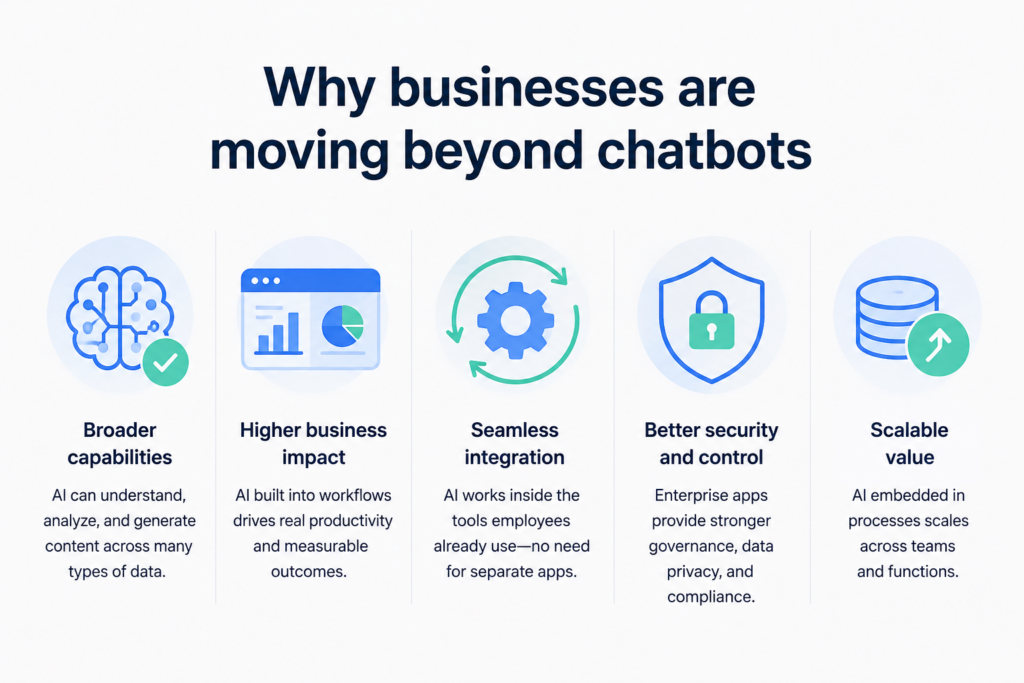
Why businesses are moving beyond chatbots
While chatbots are generally valuable for supporting customers and obtaining information, new generation AI systems are capable of summarizing documents, creating content, processing unstructured data, and helping manage complicated business processes.
Lots of businesses tend to use services for developing generative models of AI capable of embedding these features in present business software instead of creating individual AI applications.
Intelligent document processing
The use of generative AI expedites the work with different kinds of paperwork: contracts, invoices, reports, insurance claims, and regulatory documents. It allows companies to:
– Get key data for further processing
– Summarize extensive documents
– Compare different files
– Find the missing data
– Write replies
– Classify the documents
As a result, manual verification is less widely used, and employees manage to work faster.
Read: The Infrastructure Businesses Need for Seamless Hybrid Work
AI-powered knowledge systems
Company knowledge gets stored in different locations, including wikis, cloud storage solutions, email interfaces, and databases.
With the help of Integration of LLM and RAG technologies, companies can come up with systems that will search internal documents and summarize what was found.
Use cases include support in onboarding employees, resolving IT issues, clarifications of HR policies, legal advice, and technical documentation.
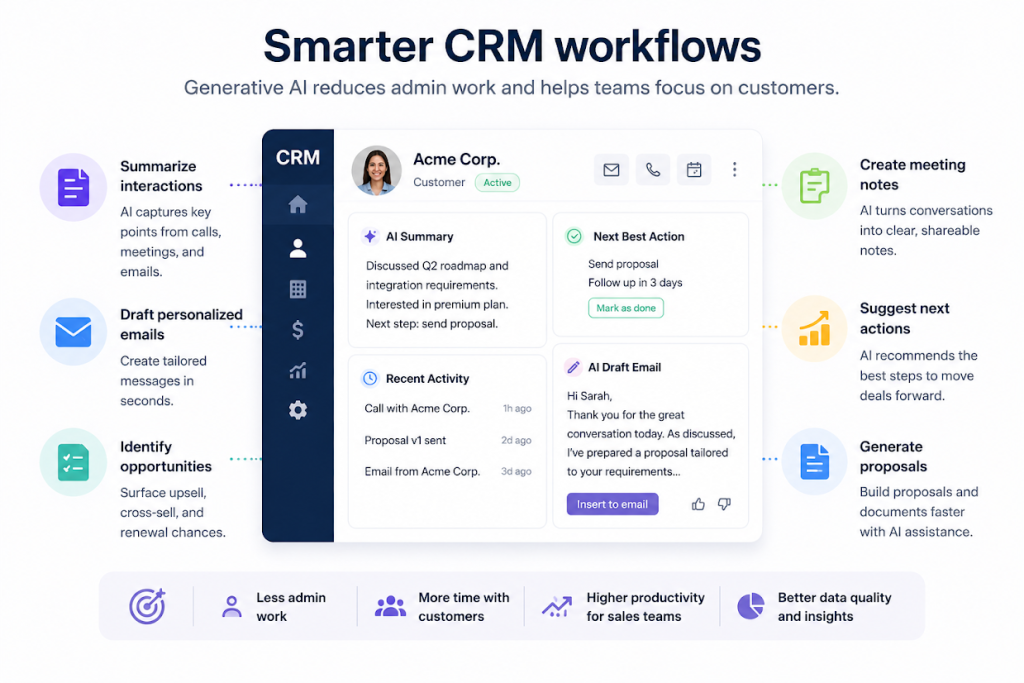
Smarter CRM workflows
With the help of generative AI, sales professionals can get rid of tedious administrative tasks:
- Summaries of meetings and phone calls.
- Email drafts.
- Automatic updates of client databases
- Recommendations on a course of action.
- Creation of the proposals.
Hence, salespeople will have more time for customer relations.
Finance and operations
The finance and operations domain of generative AI encompasses both financial applications (such as invoices, categorization of expenses, generation of reports, and contract examination) as well as logistics and supply chain systems (for example, shipment summaries, delays explanation, incidents report, and communication with vendors).
Healthcare applications
Generative AI technology can assist medical practitioners in preparing clinical notes, summarizing medical histories, classified medical files, and preparing discharge papers.
Due to the nature of the operations, which imply sensitive data and crucial decisions, human control and strict regulations should always be applied.
Software development tools
Engineering platforms increasingly adopt generative AI to carry out the following tasks:
– Generate code
– Create tests
– Explain legacy systems
– Suggest changes to the code
– Provide documentation
– Analyze submitted requests
Thanks to these tools, the developers can minimize the amount of monotonous tasks while still keeping the whole decision-making process under control.
HR and employee workflows
Using Generative AI, HR team can create job profiles, summarize applicant profiles, produce documents for orientation, clarify company policies, and make performance assessment reports.
This will save time creating repetitive paperwork.
Customer support beyond chat
AI can also help support specialists without any direct contact with clients.
It can analyze complaints, come up with responses, look for the analogous cases, find troubleshooting information, and write follow-up reports.
Common implementation challenges
The risks include:
- Inadequate quality of data
- Security and privacy issues
- Existence of hallucinations
- Demands for compliance
- Difficulties related to integration
- Minimal understanding of the domain by users
These challenges must be solved before AI is implemented on a larger scale for the organization.
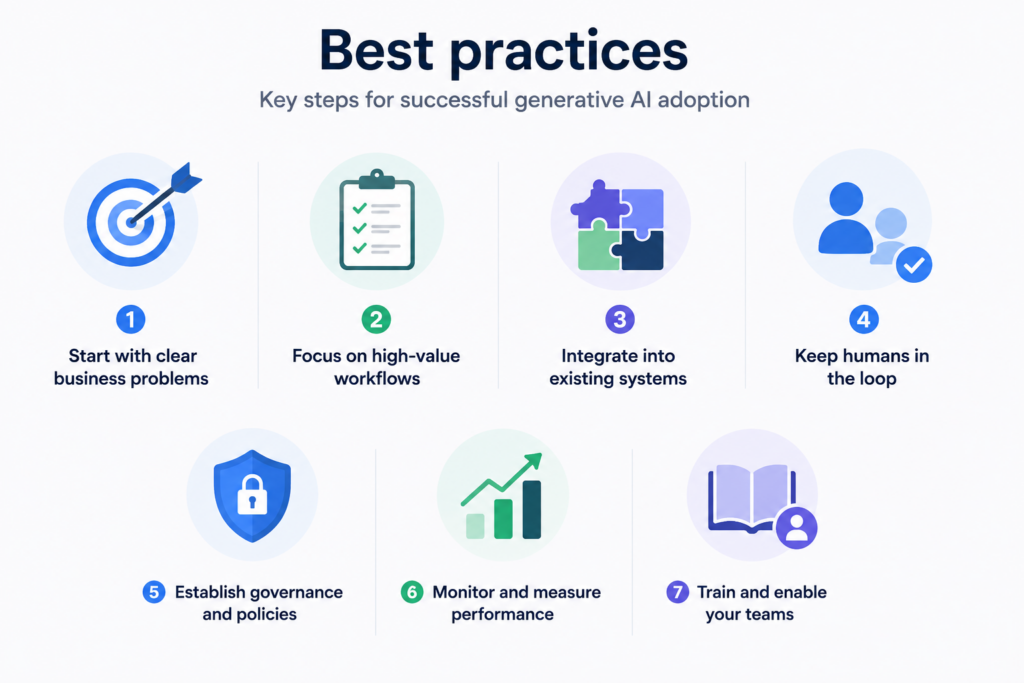
Best practices
The foundation of effective implementation is having a well-defined business issue and a constrained, high-impact process.
Businesses must make sure that they do integrate AI with the current infrastructure while making sure that human beings take part in crucial business decision-making, formalize rules of governance, supervise the results of the implementation as well as train their staff how to utilize AI properly.
Final thoughts
Generative AI goes far beyond chatbots and can improve document processing, sales, finance, healthcare, programming, logistics, human resources, and customer support. An experienced AI-assisted development team can help integrate these capabilities into real workflows, reducing manual effort, improving access to information, and supporting better decision-making.